
Health communication
CONTENTS
Immunogenicity of vaccines
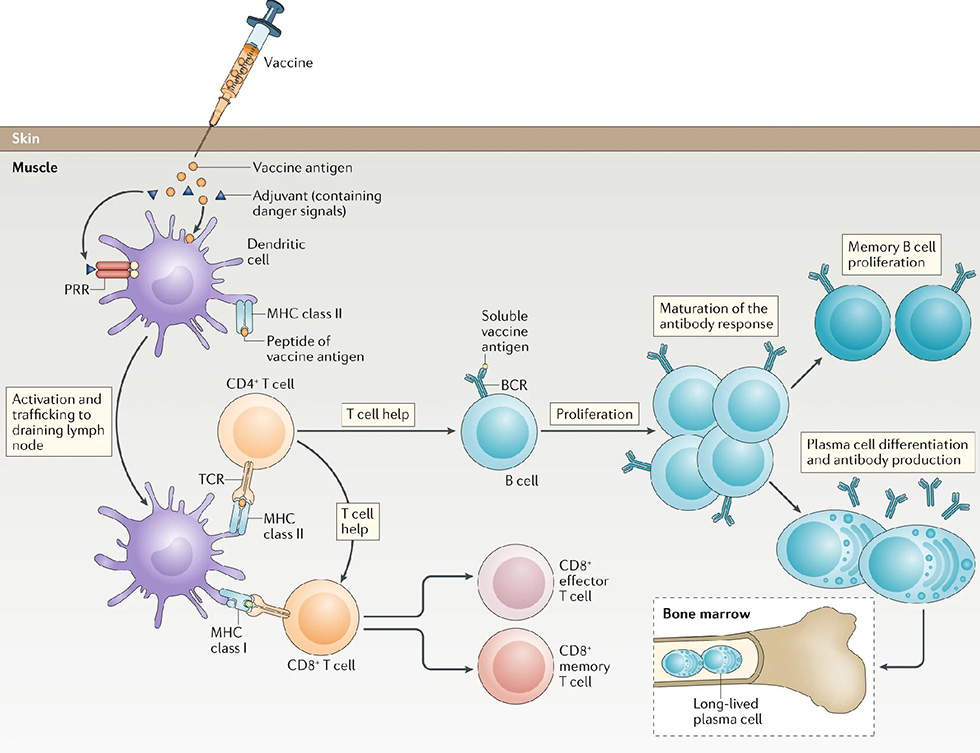
Achieving protection through vaccination is a complex challenge. Most currently available vaccines were developed largely through empirical approaches, with only limited understanding of how they activate the immune system. Their initial protective efficacy is primarily mediated by the induction of antibodies against specific antigens. Long-term protection requires either the persistence of vaccine-induced antibodies above a protective threshold or the maintenance of immune memory cells that can be rapidly and effectively reactivated upon subsequent exposure to the microorganism.
The actors that determine immune memory, as well as the relative contributions of persistent antibodies and immune memory to protection against specific diseases, are therefore essential parameters in determining the long-term effectiveness of vaccines.
Source:
Andrew J. Pollard, Else M. Bijker. A guide to vaccinology: from basic principles to new developments. Nature Reviews Immunology. 2021;21:83–100.
HOW DO VACCINES PROVIDE PROTECTION?
Vaccines provide protection by generating cells or molecules that can rapidly control replicating pathogens or neutralize their harmful components. Vaccination induces immune responses, particularly the production of antibodies by B lymphocytes, which are capable of binding to toxins or pathogens and neutralizing their effects.
Vaccines influence immune responses through different mechanisms, thereby mediating effective protection.
Polysaccharide vaccines, such as vaccines against meningococcal serogroups B and C (VA-MENGOC-BC), typhoid fever, and cholera, can stimulate T-cell-independent B-cell responses.
Conjugating bacterial polysaccharides to protein carriers, as in vaccines against meningococcal serogroups A, C, Y, and W135 (Nimenrix, MenQuadfi) or the 10-valent pneumococcal conjugate vaccine (Synflorix), converts these polysaccharides into antigens capable of eliciting a T-cell-dependent immune response. This process allows the recruitment of antigen-specific CD4 T cells to support antibody production.
T-cell-dependent antigens are also generated by toxoid vaccines, such as tetanus toxoid vaccines (adsorbed tetanus toxoid, TT/VAT) and diphtheria–tetanus vaccines (Td), as well as by inactivated or live-attenuated viral vaccines. Examples include vaccines against varicella (Barycela, Varivax, Varilrix), measles (Mvvac), and measles–mumps–rubella (MMR II, Priorix). These vaccines generally induce higher-affinity antibodies and more durable immune memory.
In addition, live-attenuated vaccines commonly activate cytotoxic CD8 T cells.
The use of live viral vector vaccines, such as the Japanese encephalitis vaccine Imojev, can induce robust CD8 T-cell responses. Most currently available vaccines mediate protection predominantly through the induction of antibodies. However, vaccine-induced CD4 T cells also contribute to protection by activating macrophages to control intracellular pathogens, as occurs with the Bacillus Calmette–Guérin (BCG) vaccine against tuberculosis, and by helping prevent pathogen reactivation, as in vaccination against varicella and herpes zoster.
The induction of antigen-specific immune responses following vaccination does not necessarily mean that antibodies, immune cells, or cytokines can automatically be regarded as reliable surrogate markers of vaccine efficacy. To establish an immune correlate of protection, it must be demonstrated that vaccine-mediated protection is associated with the presence of a specific immune marker in vaccinated individuals, such as an antibody titre or a number of antigen-specific cells above a defined protective threshold.
Therefore, for certain vaccines, assessment of the immune response after completion of the vaccination schedule may be necessary to determine whether an adequate level of protection has been achieved.
The above provides a brief and simplified explanation of the immunogenicity of vaccines.
REFERENCES
Walter A. Orenstein, Paul A. Offit, Kathryn M. Edwards, Stanley A. Plotkin. Plotkin’s Vaccines. Elsevier. 2022.
Andrew J. Pollard, Else M. Bijker. A guide to vaccinology: from basic principles to new developments. Nature Reviews Immunology. 2021;21:83–100.
MSc. Do Thi Anh Hoa
MSc. Do Thi Ngoc Anh
